Search Term Record
Metadata
Name |
I-90 |
Details |
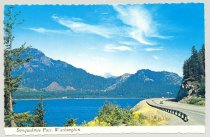
Interstate 90 (I-90), a transcontinental Interstate Highway from Seattle, Washington, to Boston, Massachusetts, crosses the state of Washington before crossing the Idaho state line between Spokane and Post Falls. It serves the cities of Seattle, Bellevue, Issaquah, Ellensburg, Moses Lake, Ritzville, and Spokane. It is the only Interstate Highway to cross the state east to west, but there are two U.S. Routes that also do the same, U.S. Route 2 and U.S. Route 12, along with a few state highways. I-90 is also the only highway in Washington to connect the two largest cities in the state (Seattle and Spokane).The road is the third busiest in the state, behind I-5 at 240,000 and I-405 at 201,000. An estimated 148,000 motorists use the road daily. I-90 incorporates two of the longest floating bridges in the world, the Lacey V. Murrow Memorial Bridge and the Homer M. Hadley Memorial Bridge, which cross Lake Washington from Seattle to Mercer Island, Washington. They are the second- and fifth-longest such bridges, respectively. As part of the state's first connected state highway system, the Washington State Legislature designated the Sunset Highway between Seattle and Idaho in 1913. Later in 1915, the Legislature also designated the North Central Highway between Ellensburg and Davenport. The State Highway Board selected two routes that would partially connect the main cities of Western Washington to Eastern Washington and Idaho. In 1923, by which time the entire road had been improved and a new connection had filled in a small gap, the Sunset Highway became State Road 2 (Primary State Highway 2 after 1937), but retained its name. The North Central Highway became State Road 7 (Primary State Highway 7 after 1937), but retained its name. Another highway, named Primary State Highway 18 between George and Ritzville. By that time, most of the route of Interstate 90 became US 10, which was established in 1926. Until 1940, the route headed south from Seattle to Renton, then east to Issaquah, in order to travel around Lake Washington. Interstate 90 crosses Lake Washington between Seattle and Bellevue on a pair of floating bridges that are two of the world's longest floating bridges. The westbound lanes travel on the Homer M. Hadley Memorial Bridge, the fifth longest floating bridge, and the eastbound lanes travel on the Lacey V. Murrow Memorial Bridge, the second longest floating bridge. The Lacey V. Murrow Memorial Bridge, originally called the Lake Washington Floating Bridge, opened on July 2, 1940. The bridge collapsed during construction on November 25, 1990. It was later rebuilt and the new bridge opened later in 1993. The second bridge, the Homer M. Hadley Memorial Bridge, opened on June 4, 1989. The new terminus of Interstate 90 after the first phase of the project.Later in 1956, President Dwight D. Eisenhower signed the Federal-Aid Highway Act of 1956 which started the construction of Interstate Highways. By 1969, US 10 was removed from the system entirely. During the construction of the freeway between Seattle and Bellevue, lawsuits were filed on May 28, 1970 and stopped construction of Interstate 90 until the early 1990s. Legally, the Washington section of I-90 is defined at Washington Revised Code § 47.17.140. In 1980, I-90 from Seattle to Thorp was designated the Mountains to Sound Greenway to protect its outstanding scenic and cultural resources. Before 2003, Interstate 90 used to end at a signalled intersection with 4th Avenue S. However, increasing traffic from Downtown Seattle, Colman Dock, Safeco Field, and Qwest Field forced city, county, and state officials to look for improvements to the area. The first stage of the improvements, the SR 519 South Seattle Intermodal Access Project, included the construction of a new on-ramp to Interstate 90 via a new interchange with 4th Avenue S. and Edgar Martínez Drive S. (formerly S. Atlantic Street). Other projects are currently ongoing and have been completed in the recent years on I-90. |
Related Records
-
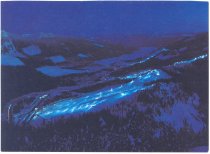
PO.040.3027 - Night Skiing at Snoqualmie Pass, Washington. Photo Donated by John Rucker of Olympia, Washington to benefit the Children's Orthopedic Hospital and Medical Center of Seattle, Washington.
Print, Photographic
Record Type: Photo
-
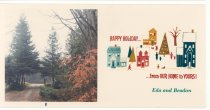
PO.325.0107.2 - C Beadon Hall Christmas Card, 1971. Happy Holiday... from our home to yours! Eda on Beadon
Print, Photographic
Record Type: Photo
-
-